From CGI to AI: Why most AI ads fall apart on full screen
A chat with Amé Raaphorst the co-founder of HAI agency on how CGI craft can meet AI and why most AI-generated work still doesn't hold up.

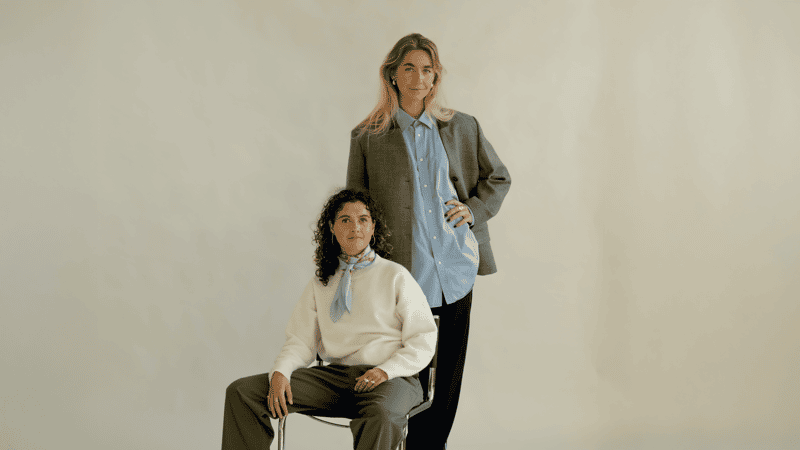
Take us to the start, what were your roots in CGI/VFX, and how did that transition into working with AI?
Zoë and I have always been driven by the same thing: a love for innovation, for adventure, for not doing what everyone else is doing. We are partners in life and in business, which means we’ve never really fit the standard mould and I think that lens is exactly what makes us see opportunities that others miss. After we graduated, we decided together that we wanted to build something. Neither of us was interested in following a conventional path.
We started exploring the 3D and CGI space because we felt something was missing in the market: brands with real creative ambition, but productions that kept delivering the same result. Zoë’s design background in design gave us the visual foundation. What gave us proof was when we created a video for a Dutch music artist, it went viral, and everything shifted. KLM, JD Sports, Heineken: that level of client shapes you fast. It demands precision, consistency, and creative direction that holds up under real scrutiny.
When AI started maturing, we weren’t starting from zero. We had years of knowing what quality actually looks like, and a point of view on what it should do for brands. That combination is what became HAI.
How does your VFX/CG background influence the way you work with AI today?
It’s everything. What makes our work different from the wave of AI-generated content flooding feeds right now is the combination: CGI, VFX, and AI working together. AI alone is still limited. It can produce something impressive at a glance and fall apart at full screen. The craft, the understanding of how light, depth, motion, and texture behave in the real world, is what closes that gap. That’s also what our name stands for: Humans x AI.
Zoë looks at an AI output and immediately sees what’s wrong: the shadow behaviour, the motion physics, the frame-rate artifact that’s going to give it away on a phone screen. That’s years of production experience applied to a new toolset. The combination is what creates the standard we hold ourselves to.
What role does traditional 3D still play in your work? What’s the current split between AI and 3D at HAI?
We don’t think in those terms. The question on every project is what serves the creative, not which tool produced which frame. Sometimes we’re working in fully generative pipelines. Sometimes we’re combining 3D renders with AI-enhanced compositing. Sometimes we need traditional CGI for the elements that require structural precision and AI on top for environment, texture, or motion. The split changes per project, per brief, per budget.
Where do you still hit limits with AI today?
Consistency in video is the main one. The moment you need a specific product, character, or object to look exactly the same across fifteen seconds of footage, you’re managing something the current generation of models doesn’t solve cleanly. That adds a layer of manual work that people outside production often don’t account for in timelines or budgets.
Is there a recent project where AI made something possible that wasn’t before?
Two projects come to mind that really show the difference between using AI as a tool and rebuilding what production can actually do.
Heineken: we built a fully custom AI workflow enabling hyper-personalization at scale. Every horeca venue (every individual café, bar, restaurant) gets high-quality creative tailored specifically to them. It’s a production pipeline that multiplies human creative direction across thousands of outputs without ever dropping the visual standard. We’re now rolling this out for multiple brands.
Bol is another strong example. We applied AI to their interior shoots in two ways. The first was fully AI-generated environments that go further than what any studio could physically build or photograph: scenes that simply don’t exist, rendered to a standard that holds up next to real photography. The second was taking a single real shoot and generating an entire home in the same visual style across different products and rooms. One photo became a complete world. That ability to expand what already exists - to go from one asset to many without losing the quality or the creative coherence - that’s what expanded creativity means in practice. And it’s the thing clients keep coming back for.
Has AI changed how clients review and approve work?
Significantly. The iteration speed has changed the early creative conversation. When a revision used to mean three days and a budget discussion, clients were more conservative about what they asked for. Now we can put two directions on the table in the same meeting, and the conversation gets more honest faster.
What’s also shifted is how important it’s become to take clients along in the process. Transparency has always been part of how we work, but AI requires a specific kind of education and understanding to collaborate well. We always explain precisely what we’re going to build and how. Because trust is essential in a good partnership and it’s the foundation of quality work.
The result is that clients are almost always surprised by their first results. That moment, when someone sees what actually became possible, is exactly what we do it for.
Where do you think production in general is heading in the next 12 to 18 months?
Creativity just entered a new era and most brands haven’t realised it yet.
The agencies still treating AI as a plugin inside a legacy workflow (the same briefs, the same timelines, the same trade-off between quality and speed) are going to feel real pressure, because the gap between what those agencies can deliver and what an innovative, young team can deliver is only going to widen.
What almost everyone underestimates is that the creative standard is going to rise at the same time costs compress. Clients are going to expect more, not less. Safe creatives don’t hold up in that environment. So safe is not a strategy. It’s a slow fade.
The brands that understand this now - the ones bold enough to move while others are still catching up - are the ones that will define what great brand content looks like for the next
What studios or creatives do you follow right now?
One of the most exciting things happening right now is the rise of independent AI creatives. Because AI has lowered the barrier to entry, individuals can now produce work that competes with full studios. We think that’s fantastic, and we follow them closely, both on the technical side and the purely creative side.
Sophie Hospes is someone we know personally, and she’s a great example of how you can build entire brand worlds today with AI at the centre of your creative direction. Gizem Akdag does beautiful work as well. A real visual signature in everything she makes. And then there’s Sef Hansen — someone we’ve been following for a long time and genuinely admire for his creative vision and technical range. We’re excited to announce that he’s joining the HAI team. Which says something about how we think about growth: we are always looking for what we call HAI-performers. People with an independent creative vision and a mindset that genuinely welcomes innovation. A point of view and the willingness to push into unknown territory. Those are the people who move the work forward.
What will happen to “traditional” VFX studios and artists?
The ones who treat technical skill as the product are going to struggle. The ones who understand that technical skill exists in service of a creative vision, those people will be fine. Actually, they’ll be more valuable, because that combination is hard to replicate.
There will be consolidation. The market is already separating the agencies that evolved from the ones that didn’t. What fills that space isn’t AI. It’s smaller, faster teams with higher craft standards and a different production and cost approach. That’s exactly what we are.
What skills are becoming less important and which ones are becoming more valuable?
Execution for execution’s sake is worth less than it was. If your value proposition is “we produce X assets in Y days,” that equation has changed permanently and it is not changing back.
What’s becoming more valuable: taste, creative direction, the ability to concept and art-direct at speed, and the judgment to know when something is ready and when it isn’t. Anyone who can build and manage generative pipelines at production scale is in a strong position. That combination is still genuinely rare.
The skill most people underestimate right now is brand thinking. As production becomes cheaper and faster, the strategic question of what to make and why it matters becomes the real bottleneck. That’s where the leverage is. And that’s what we bring to every brand we work with.