What if NASA designed sunglasses with Oakley?: How we created a NASA x Oakley AI spec ad using NanoBanana Pro, Cinema Studio, and Kling 3.0
A step-by-step breakdown of designing a fictional NASA x Oakley sunglasses concept, generating lunar campaign frames with AI, and animating it into a cinematic spec ad — prompts included.

You know the struggle.
You want to stay up to date, but the amount of information around AI tools, workflows, and what works best is overwhelming.
Every week there’s a new tool. Every day a new workflow.
And it’s hard to tell what’s actually useful.
That’s exactly why we’re doing this series.
Instead of theory, we break things down into practical, replicable workflows — using fictional spec ads to show what’s possible, and how to actually get there.
For this week’s breakdown, we wanted to build something that feels like performance eyewear pushed beyond Earth.
The idea started with one simple question:
What if NASA designed sunglasses with Oakley?
Because a fictional NASA x Oakley collab shouldn’t feel like a normal sportswear drop.
It should feel like technical equipment.
Like astronaut EVA gear.
Like something made for lunar terrain, harsh sunlight, and seeing beyond Earth.
So we wanted to build a full campaign system around that idea.
For this workflow, we used:
- NanoBanana Pro for product and campaign image generation
- Cinema Studio Image for cinematic stills
- Kling 3.0 for animation
- Cinema Studio Video for controlled product motion
Not a reader? Check out the interactive workflow at the end of the post.
Now, let’s get into it.
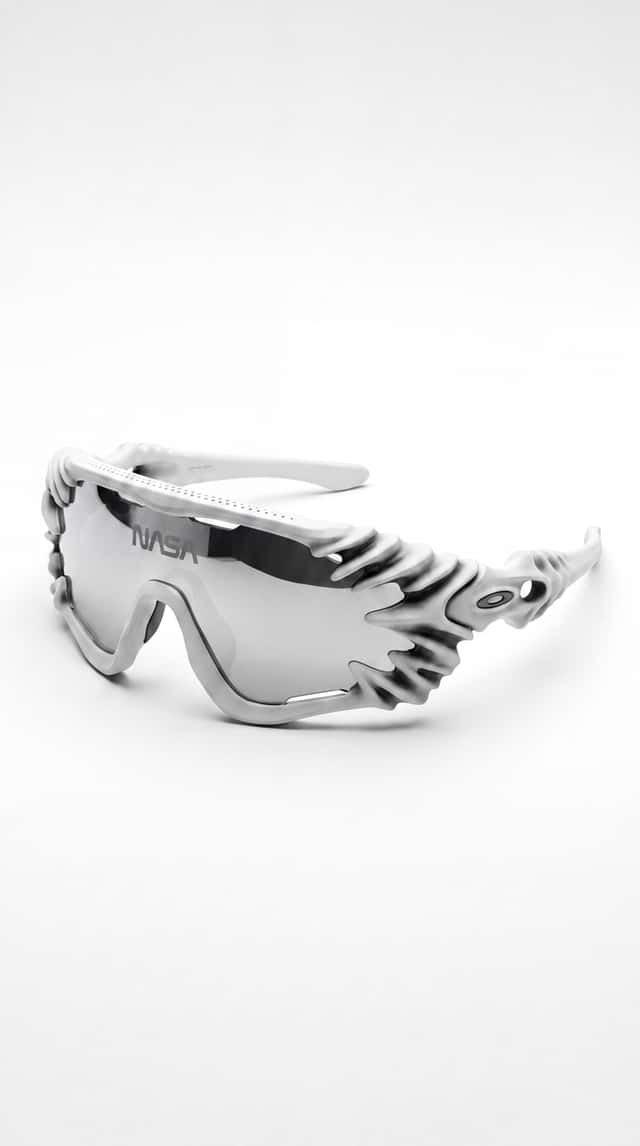
Step 1 — Designing the Core Product in NanoBanana Pro
Everything started with the product design.
Instead of generating a generic pair of futuristic sunglasses, the goal was to create something with a believable design logic:
- an Oakley-inspired wraparound shield silhouette
- a compact 2000s performance eyewear shape
- a sculpted exoskeletal frame
- lunar engineering cues
- NASA branding that feels technical, not decorative
The key was to make the sunglasses feel like equipment.
Not fashion eyewear.
Not a regular collab colorway.
But a fictional piece of performance PPE designed for space conditions.
Ready-to-copy prompt
Product photography of a NASA × Oakley collaboration concept sunglass, fictional collab piece. Form language fuses two references: (1) compact 2000s-era Oakley wraparound silhouette — low-profile, close-to-face, single continuous brow-line lens with subtle scoop at the nose bridge, narrow vertical lens height; (2) heavily sculpted exoskeletal frame architecture — aggressive organic ribbed “vertebrae” / bone-like texture covering the entire frame and temples, deep parametric grooves and ridges flowing along arms and intruding into the outer lens edges with asymmetric organic cutouts that bite into the lens shape, like aerospace heat-shield tiling fused with spinal armor / biomechanical skeleton, pronounced 3D relief catching light dramatically.
Rimless wraparound shield lens with irregular organic edge profile shaped by the surrounding skeletal frame. Reflective mirrored chrome finish, highly glossy and mirror-like, reflecting the studio lights and surrounding environment clearly, no transparency, no low-reflectivity tint.
Frame in deep matte white with charcoal accents in the rib recesses for depth — full white colorway. NASA “worm” logotype laser-etched in dark grey tone-on-tone. Micro-perforated venting along the upper brow.
Aesthetic reads as astronaut EVA equipment crossed with sport-performance eyewear and biomechanical exoskeleton — technical PPE, not fashion. Studio product shot, seamless pure white background, soft key light from above, crisp rim light along temple ribs to emphasize the sculpted texture, 3/4 hero angle, ultra-clean commercial photography, 8K, no people, no face.
Negative prompt: generic aviator, round frames, smooth flat frame, full plastic frame around lens, chrome frame, blue lens, iridium gradient, fashion-y, oversized, Y2K cyber, model wearing them, face visible, hands.
This image became the main product reference for the rest of the campaign.
The most important detail here was the frame language: the sculpted white ribs, the organic lens edge, and the idea that the product looks engineered rather than styled.
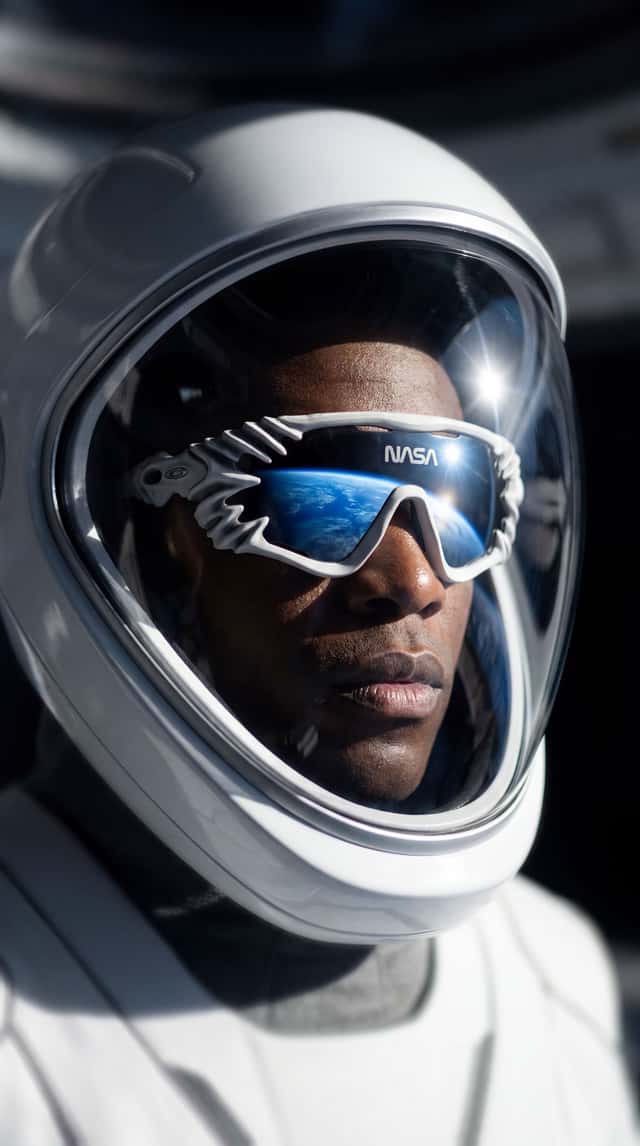
Step 2 — Placing the Product on the Moon
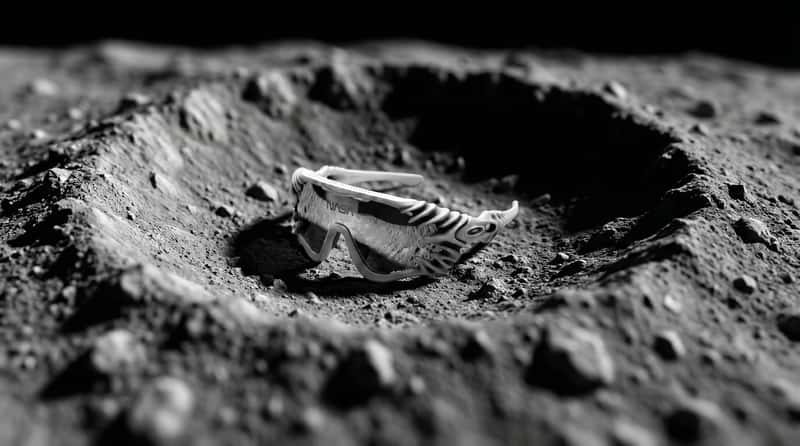
Once the core product was locked, we moved it into the world it belonged in: the lunar surface.
The goal was to create a hero product shot that immediately communicates the campaign idea.
A pair of sunglasses.
Resting in a lunar crater.
Lit like Apollo-era documentation, but composed like a modern product campaign.
Ready-to-copy prompt
We also created a more reduced version of the same idea for another product frame.
These frames helped set the visual world: monochrome, sharp, technical, and cinematic.
Step 3 — Expanding the Visual System
After the crater shot, we wanted the campaign to feel bigger than one product image.
So we built out a set of additional campaign frames around three directions:
- lunar texture and material studies
- human performance on the Moon
- scientific mapping and orbital references
That gave the fictional campaign more range and made it feel like a full visual system rather than a single AI render.
Texture study prompt
This shot was useful because it translated the lunar surface idea into something more abstract and tactile.
It feels less like a literal moon shot and more like a material campaign image.
Running astronaut prompt
Full-body cinematic shot of a Black male model running across a moon-like grey surface, wearing a full white futuristic outfit inspired by astronaut EVA suits — minimal, matte white, clean panel construction, subtle technical seams. He’s wearing the exact image_1 eyewear.
Environment resembles a lunar landscape: rough, cratered terrain, dusty grey textures, deep shadows, black sky with no atmosphere. Fine particles float slightly in low gravity, subtle dust trails follow each step.
Lighting is harsh and directional, like a distant sun — strong highlights on the white suit, deep contrast shadows, slight bloom on edges. The glasses catch sharp specular reflections.
Camera tracks sideways in slow motion, slightly low angle. Movement feels light but powerful, almost reduced gravity. Dust lifts and hangs longer than normal.
Heavy film grain, analog texture, slightly underexposed blacks, high contrast, subtle glow and noise in shadows — giving a raw, archival NASA-footage feel.
Mood: otherworldly, performance beyond Earth.
Style: high-end adidas/NASA campaign, cinematic, gritty, monochrome, textured, not clean — imperfect and tactile.
This became the performance layer of the campaign.
The sunglasses are no longer just a product on a surface.
They become part of a world, a body, and a movement system.
Helmet close-up prompt
This shot added the emotional campaign moment.
The reflection of Earth in the lenses gives the product a clear visual payoff:
this is eyewear designed for a world beyond the one we know.
Step 4 — Creating Campaign Assets
To make the NASA part of the concept feel more authentic, we also created orbital and documentation-style frames.
These are useful because they break up the campaign visually.
Instead of only showing product and model shots, you get a layer that feels like mission data, mapping, and exploration.
Lunar orbital map prompt
Lunar surface texture prompt
These frames work especially well as transitions, overlays, or background plates for motion.
They help the whole piece feel less like a product render and more like a fictional mission archive.
Step 5 — Building the Motion in Cinema Studio and Kling 3.0
With the stills ready, we moved into video.
The goal was not to animate everything aggressively.
For a concept like this, the motion has to feel controlled and physical.
We focused on:
- lunar dust movement
- slow product reveals
- close-up reflections
- tracking shots
- archival texture
- simple but cinematic camera motion
Lunar ground upheaval prompt
Product reveal prompt
This was one of the strongest motion ideas because it connects the surface texture directly to the product reveal.
The moon doesn’t just act as a background.
It becomes part of the product introduction.
Astronaut reflection prompt
Lunar running prompt
Product rotation prompt
Cinematic product shot of the exact @image_1 sunglasses floating above the surface of the moon, fine lunar dust and subtle footprints visible below, low gravity environment, Earth visible in the distance on the horizon, deep black space background.
The glasses slowly lift, hover and perform a smooth 360-degree rotation in mid-air, elegant and controlled motion, realistic weight despite low gravity, no abrupt movement.
Lighting is harsh directional sunlight typical of the moon, strong shadows, high contrast, cold monochrome palette with subtle blue glow from Earth reflections on the lens.
Camera: slow floating tracking shot, slight orbital movement around the glasses, minimal drift, cinematic stabilization, shallow depth of field.
Atmosphere: silent, minimal, surreal but realistic, slight film grain, high-end VFX, 8K, no text, no logo distortion.
Overhead lunar walk prompt
The camera follows him smoothly from above as he walks backward slowly across the lunar surface. His steps are heavy and controlled, moving in reverse with subtle moon dust lifting around his boots and soft footprint impressions forming as he steps back.
Keep the composition close to the vertical frame: model centered, Earth visible in the background above the lunar horizon, deep black space, grey moon surface, harsh sunlight, strong shadows. Maintain the exact white outfit, sunglasses shape, face, lighting, and realistic lunar texture.
The camera movement should feel like a slow floating drone shot: slight backward tracking with him, minimal drift, no cuts. Add subtle parallax in the moon surface, small dust particles, and gentle atmospheric film grain. The Earth should remain stable in the distance, slightly glowing and out of focus.
High-end VFX, photorealistic, 8K, cinematic contrast, monochrome lunar palette with blue Earth accent, slow motion, smooth continuous motion, no camera shake, no extra people, no text, no logo distortion.
Interactive Node Workflow
If this was useful, you’ll like FAST FORWARD.
It’s our weekly signal on:
- emerging creative workflows and AI news
- standout AI + CGI work
- ideas you can actually apply
No noise. Just things worth paying attention to.