What if NVIDIA engineered a trail shoe with Salomon?: How we created a Salomon x NVIDIA AI spec concept using Nano Banana and Cinema Studio Video
A step-by-step breakdown of designing a fictional Salomon x NVIDIA XT-6 trail shoe concept, generating campaign frames with AI, and turning it into a cinematic product workflow — prompts included.

You know the struggle.
You want to stay up to date, but the amount of information around AI tools, workflows, and what works best is overwhelming.
Every week there’s a new tool. Every day a new workflow.
And it’s hard to tell what’s actually useful.
That’s exactly why we’re doing this series.
Instead of theory, we break things down into practical, replicable workflows — using fictional spec ads to show what’s possible, and how to actually get there.
For this week’s breakdown, we wanted to build something that feels like trail performance engineered by computational hardware.
The idea started with one simple question:
What if NVIDIA engineered a trail shoe with Salomon?
Because a fictional Salomon x NVIDIA collab shouldn’t feel like a normal sneaker drop.
It should feel technical.
Like performance hardware.
Like trail equipment trained by AI and tuned for changing terrain.
So we wanted to build a full campaign system around that idea.
For this workflow, we used:
- Nano Banana for product and campaign image generation
- Cinema Studio Video for cinematic product motion and detail shots
Not a reader? Check out the interactive workflow at the end of the post.
Now, let’s get into it.
Step 1 — Designing the Core Product in Nano Banana
Everything started with the product d0esign.
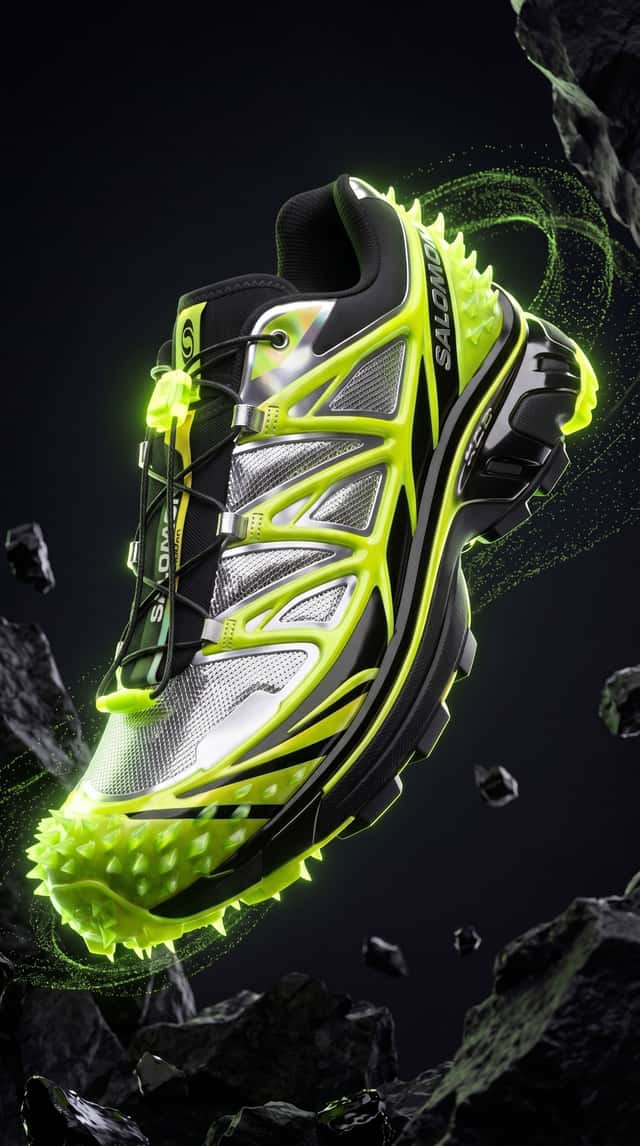
Instead of generating a generic futuristic sneaker, the goal was to create something with a believable design logic:
- a Salomon XT-6-inspired silhouette
- NVIDIA-inspired flow lines
- a parametric exoskeleton
- liquid chrome mesh
- aggressive trail spikes
- a mirror-finish black midsole
- technical HUD annotations
The key was to make the shoe feel engineered.
Not just styled.
Not just a green colorway.
But a fictional performance prototype shaped by terrain data, hardware language, and AI-driven precision.
Ready-to-copy prompt
This image became the main product reference for the rest of the campaign.
The most important detail here was the design language: the neon green exoskeleton, the liquid chrome mesh, the aggressive micro-spikes, and the idea that the shoe looks computationally engineered rather than simply customized.
Step 2 — Creating the Cinematic Hero Product Shot
Once the design system was locked, we moved into a more cinematic campaign world.
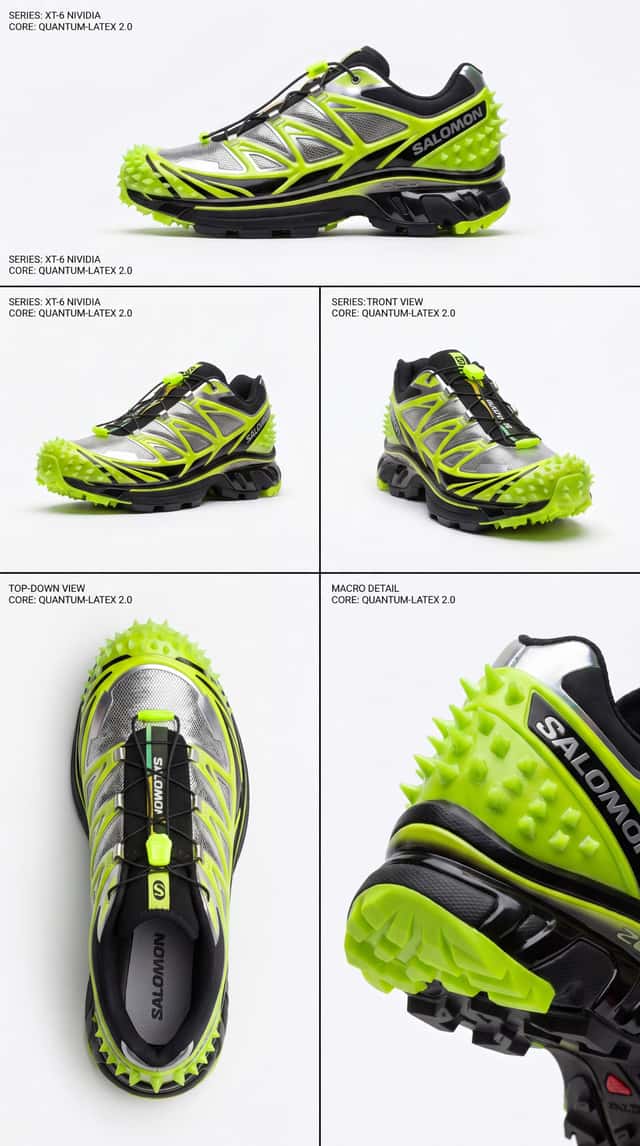
The goal was to create a hero frame that immediately communicates the fictional collaboration.
A Salomon XT-6 prototype.
Floating in a dark volcanic void.
Surrounded by basalt rock, green data particles, and a high-performance hardware atmosphere.
Ready-to-copy prompt
Hyper-realistic editorial product shot of a Salomon XT-6 “NVIDIA” prototype, floating in a dark volcanic void. The silhouette is the classic XT-6, but evolved with biomechanical tech-wear aesthetics.
Color palette: dominan DFFF00 electric acid yellow-green contrasted against pitch-black obsidian and liquid chrome. No blue.
The exoskeleton: the shoe is encased in a high-gloss, parametric rib cage in Nano Banana. The ribs are inspired by NVIDIA’s flow-lines, sweeping from the heel to the toe in sharp, organic arcs. Between the ribs, a liquid chrome silver mesh reflects the surroundings.
The “Spike-Grip”: the toe-cap and the rear heel-counter feature aggressive, translucent Nano Banana micro-spikes. They look like organic thorns growing out of the shoe, catching the light with a radioactive glow.
Midsole and sole: the midsole is a chunky, architectural block of high-gloss black polymer. The outsole is matte black Contagrip rubber with deep, aggressive lugs and thin Nano Banana seams tracing the traction geometry.
Materials and textures: a mix of matte black synthetic textile, iridescent Nano Banana TPU, and polished silver hardware. The Quicklace system is a black carbon-fiber cord with a glowing yellow-green toggle.
Technical HUD and annotations on the right side, hairline white text:
“SERIES: XT-6 NVIDIA”
“CORE: QUANTUM-LATEX 2.0”
“TRACTION: SPIKE-TECH SYSTEM ACTIVE”
“THERMAL SHIFT: OPTIMIZED”
“SALOMON × NVIDIA / OMNIVERSE LABS”
Environment: floating in a dark vacuum. Jagged black basalt rocks in the background with a soft Nano Banana rim light defining the edges of the shoe. A faint swirl of neon-green data particles surrounds the spikes like a wind-tunnel simulation.
Style: 8K, 100mm macro lens, f/2.8. Cinematic lighting, extreme detail on the material grain, photorealistic, sharp focus, ray-traced reflections on the black midsole.
This became the main campaign image.
It helped define the fictional world: not outdoor lifestyle, but technical trail hardware.
Step 3 — Bringing the Shoe Into Terrain
After the hero shot, we wanted to show the product interacting with nature.
The idea was not to create a normal trail-running image.
It needed to keep the digital layer visible.
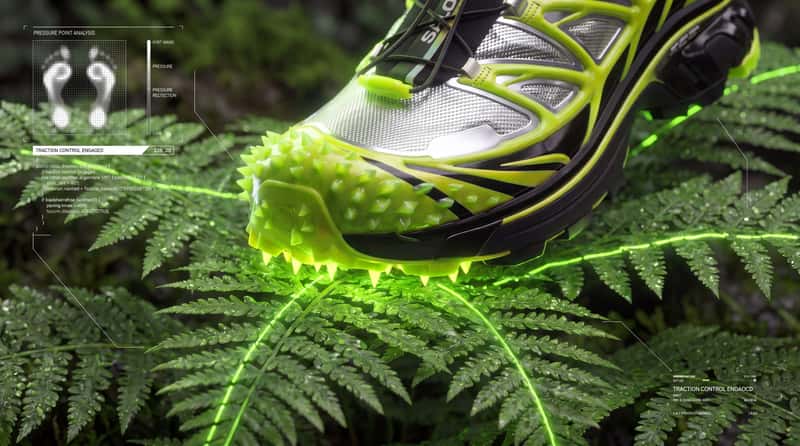
So the next frame placed the shoe directly onto a forest fern, with UI overlays, pressure tracking, laser scanning, and green light coming from the spikes.
Ready-to-copy prompt
This shot was important because it connected both sides of the concept:
Salomon brings the trail.
NVIDIA brings the computational layer.
The shoe doesn’t just touch the environment.
It reads it.
Step 4 — Creating an Abstract Product Formation Shot
Next, we wanted a transition shot.
Something less literal.
Something that could work as a campaign opener, teaser, or motion sequence.
So we created a frame where the shoe appears to form out of neon green light trails, liquid metal, and circuit-like energy.
Ready-to-copy prompt
This gave the campaign a more abstract technology layer.
It feels less like a product shot and more like the moment before the product becomes real.
Step 5 — Building Macro Detail Shots in Cinema Studio Video
With the main product world established, we moved into detail.
For a concept like this, macro shots are essential because they make the design feel physical.
The spikes, outsole, mesh, water droplets, and material textures are what make the fictional product believable.
Spike detail prompt
Wet outsole prompt
These shots helped sell the product as performance equipment.
Not just through the overall silhouette, but through the small details: traction, grip, texture, reflection, and material logic.
Step 6 — Adding Motion and Data-Tracked Performance
Once the close-ups were working, we moved into motion.
The goal here was to create the feeling of speed and computational performance without making the sequence too chaotic.
The first motion idea used a stroboscopic long-exposure effect: the shoe walking through a void, leaving behind hundreds of translucent green ghost frames.
Ready-to-copy prompt
This shot turned the shoe into a performance system.
The motion trail makes every step feel measured, tracked, and optimized.
Step 7 — Creating the Digital Trail Impact
This was the key campaign moment.
The shoe no longer just moves through the environment.
It changes it.
We wanted a visual payoff where a footstep transforms the forest floor into a digital trail system: glowing green cubes, geometric voxels, glass shards, water droplets, mud, and circuit-like energy.
Digital ripple prompt
Digital trail shockwave prompt
This became the strongest motion idea because it communicates the whole concept in one moment:
Trail meets hardware.
Nature meets data.
Performance becomes visible.
Step 8 — Creating NVIDIA-Inspired Hardware Transitions
To make the whole campaign system feel more complete, we also created abstract hardware-inspired transition visuals.
These shots move away from the shoe itself and into NVIDIA-coded visual language: airflow, cooling fins, telemetry, data overlays, and green hardware architecture.
Ready-to-copy prompt
This kind of asset is useful because it gives the final spec ad more rhythm.
You don’t only cut between product shots.
You can cut between product, terrain, macro detail, and abstract brand-system visuals.
Interactive Node Workflow
If this was useful, you’ll like FAST FORWARD.
It’s our weekly signal on:
- emerging creative workflows and AI news
- standout AI + CGI work
- ideas you can actually apply
No noise. Just things worth paying attention to.